Puebla sits to the east of two Volcanoes, Popocatépetl and Iztaccihuatl.

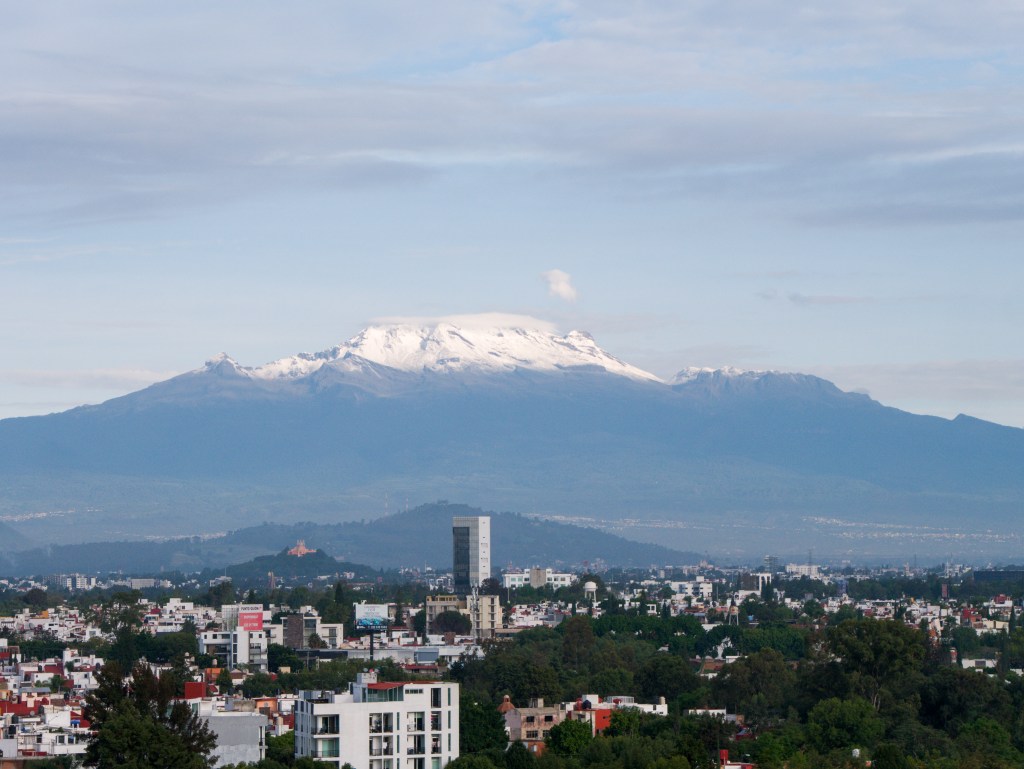
Local legend says thatIztaccíhuatl was a princess who fell in love with one of her father’s warriors, Popocatépetl. The emperor sent Popocatépetl to war in Oaxaca, promising him Iztaccíhuatl as his wife when he returned. Iztaccíhuatl was falsely told that Popocatépetl had died in battle, and believing the news, she died of grief. When Popocatépetl returned to find his love dead, he took her body to a spot outside Tenochtitlan and knelt by her grave. The gods covered them with snow and changed them into mountains. Iztaccíhuatl’s mountain is called “White Woman” because it resembles a woman lying on her back, and is often covered with snow. Popocatépetl became an active volcano, raining fire on Earth in blind rage at the loss of his beloved.
This is a legend from Pre-Spanish Mythology, but it is still lasting today. The effects of the Catholic Conquista de Mexico (Conquest of Mexico) are still seen. The Spanish friars and conquistadors tried to convert the indigenous population to Catholicism but ultimately failed. The major lasting effect is a religious culture of syncretism.
Syncretism is the blending of different, often contradictory, beliefs, practices, or philosophies into a new, unified system.
The Catholics were unsuccessful in creating a true version of Catholicism and just produced a great mixture of Catholicism with Pre-Hispanic religions, hence the story of the two lovers turned into mountains. One example of this compound is Dia de los Muertos or The Day of the Dead. This “holiday” has been popularized worldwide through the Disney film Coco. It is the belief that the spirits of ancestors are able to return to this plane of existence in search of honor, recognition, and remembrance. The duty of the living is to provide offerings to help the spirits of their ancestors return and be honored.

There shall not be found among you anyone who burns his son or his daughter as an offering, anyone who practices divination or tells fortunes or interprets omens, or a sorcerer or a charmer or a medium or a necromancer or one who inquires of the dead, for whoever does these things is an abomination to the LORD. (Deut. 18:10–12) (emphasis mine)
Within the true Christian Worldview, there is no place for Dia de Los Muertos.
With learning Spanish and Mexican culture, knowing the underlying beliefs and cultural understandings of Mexicans is important for bridging to the Gospel. The Gospel and the Bible are true in every culture including Mexico, even when the environment seems dark and focused on death and suffering.
The gospel gives hope in the midst of darkness. Jesus came into the world to save sinners, people who think that on their own they are good enough to earn righteousness or a place in heaven. One pastor put it this way, “The gospel is this: We are more sinful and flawed in ourselves than we ever dared believe, yet at the very same time we are more loved and accepted in Jesus Christ than we ever dared hope.”
Christ has come and has called all of us as Christians to share the Good News of the Gospel, that far off sinners can be made near and reconciled to a Holy God through the perfect life, death, and resurrection of the Lord Jesus Christ.
4 In him was life, and the life was the light of men. 5 The light shines in the darkness, and the darkness has not overcome it.
John 1:4-5


Leave a comment